Crypta: Memory, Symbols, and a Mysterious Table
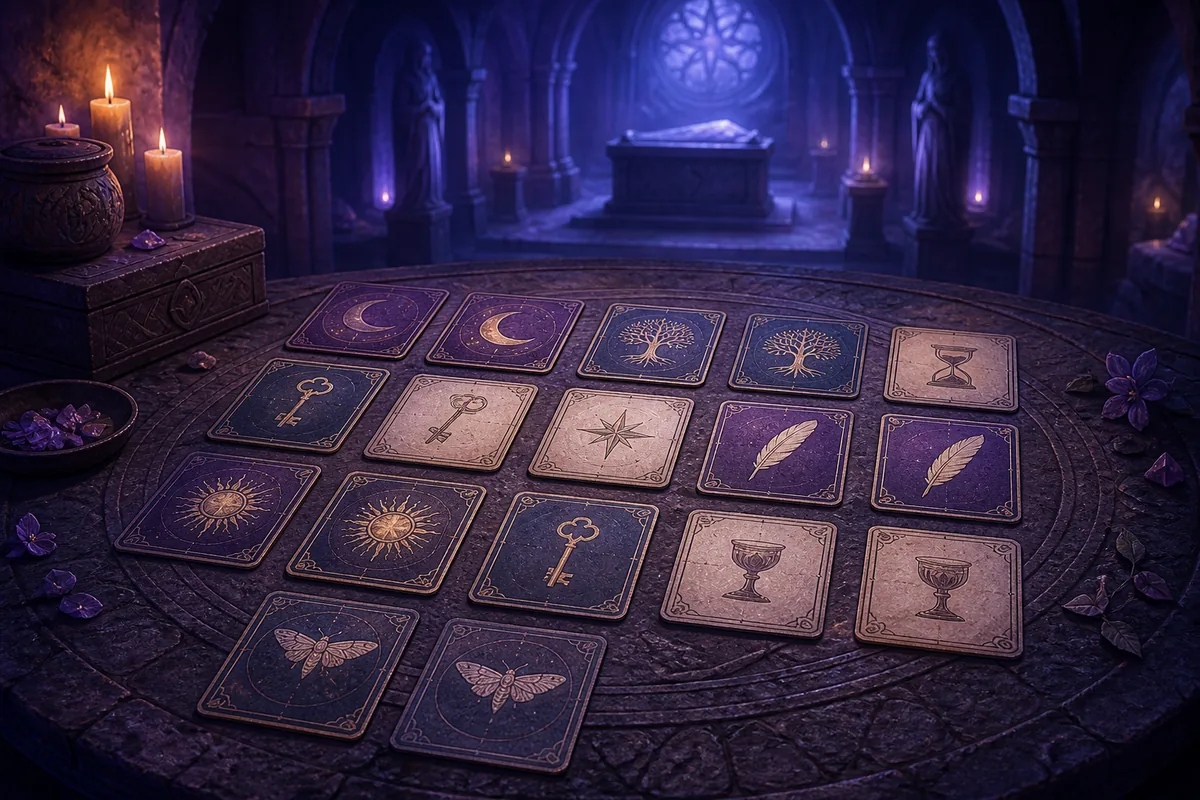
Crypta confirms a simple instruction: match cards of the same type. This article explores how repeated symbols, card placement, and a restrained crypt atmosphere can support memory without adding unverified scoring or progression details.
Design Review
Memory Depends on Stable Placement
A regular grid provides coordinates even when no labels are present. The relationship between rows, columns, and nearby cards supplies a spatial reference, allowing an icon to be recalled as both an image and a location.
Atmosphere Should Preserve Clarity
Violet light and stone textures create mystery, but the cards still need stronger contrast than the table beneath them. Decorative candles and architecture work best outside the central matching area. The hero image is original editorial artwork.
Pairs Create a Visual Vocabulary
Moons, keys, trees, and other clear symbols can be remembered more easily when every icon has a distinct outline. Consistent card dimensions and spacing let attention move between identity and position instead of fighting an irregular layout.
Details in Focus
- Scan the full arrangement before selecting.
- Associate each symbol with its position.
- Compare silhouettes instead of minor ornament.
- Pause after each reveal to register the result.
Conclusion
Crypta’s clearest idea is the contrast between a mysterious setting and a precise matching task. Stable spacing and memorable symbols keep that relationship understandable.
Access and Related Puzzles
Crypta opens on GamesX. It belongs to the Puzzle Games category. Recent additions can be found on the GamesX homepage.
Extended Design Review
A design-focused review of Crypta should test the article’s claim about Design Review against the whole composition. Edges, scale changes, tonal separation, and negative space determine whether that relationship remains readable. The specific note “Compare silhouettes instead of minor ornament” supplies an article-based reference, so the discussion can develop from material already established rather than from an invented feature. The conclusion is therefore about communication, not about unverified performance or play systems.
In Crypta, the technical importance of Memory Depends on Stable Placement lies in how it affects visual hierarchy. This method treats the image as a designed system rather than as evidence for mechanics that have not been documented. The specific note “Pause after each reveal to register the result” supplies an article-based reference, so the discussion can develop from material already established rather than from an invented feature. The conclusion is therefore about communication, not about unverified performance or play systems.
The clearest critical entry into Crypta is the relationship summarized by Atmosphere Should Preserve Clarity. The detail can be evaluated at thumbnail size and again at full width, revealing whether the hierarchy remains consistent. The specific note “Scan the full arrangement before selecting” supplies an article-based reference, so the discussion can develop from material already established rather than from an invented feature. The conclusion is therefore about communication, not about unverified performance or play systems.
A design-focused review of Crypta should test the article’s claim about Pairs Create a Visual Vocabulary against the whole composition. Edges, scale changes, tonal separation, and negative space determine whether that relationship remains readable. The specific note “Associate each symbol with its position” supplies an article-based reference, so the discussion can develop from material already established rather than from an invented feature. The conclusion is therefore about communication, not about unverified performance or play systems.
In Crypta, the technical importance of Details in Focus lies in how it affects visual hierarchy. This method treats the image as a designed system rather than as evidence for mechanics that have not been documented. The specific note “Compare silhouettes instead of minor ornament” supplies an article-based reference, so the discussion can develop from material already established rather than from an invented feature. The conclusion is therefore about communication, not about unverified performance or play systems.
The clearest critical entry into Crypta is the relationship summarized by Conclusion. The detail can be evaluated at thumbnail size and again at full width, revealing whether the hierarchy remains consistent. The specific note “Pause after each reveal to register the result” supplies an article-based reference, so the discussion can develop from material already established rather than from an invented feature. The conclusion is therefore about communication, not about unverified performance or play systems.
A design-focused review of Crypta should test the article’s claim about Access and Related Puzzles against the whole composition. Edges, scale changes, tonal separation, and negative space determine whether that relationship remains readable. The specific note “Scan the full arrangement before selecting” supplies an article-based reference, so the discussion can develop from material already established rather than from an invented feature. The conclusion is therefore about communication, not about unverified performance or play systems.
In Crypta, the technical importance of Design Review lies in how it affects visual hierarchy. This method treats the image as a designed system rather than as evidence for mechanics that have not been documented. The specific note “Associate each symbol with its position” supplies an article-based reference, so the discussion can develop from material already established rather than from an invented feature. The conclusion is therefore about communication, not about unverified performance or play systems.
The clearest critical entry into Crypta is the relationship summarized by Memory Depends on Stable Placement. The detail can be evaluated at thumbnail size and again at full width, revealing whether the hierarchy remains consistent. The specific note “Compare silhouettes instead of minor ornament” supplies an article-based reference, so the discussion can develop from material already established rather than from an invented feature. The conclusion is therefore about communication, not about unverified performance or play systems.