Gun Evolution Game: Visual Change Along a Forward Route
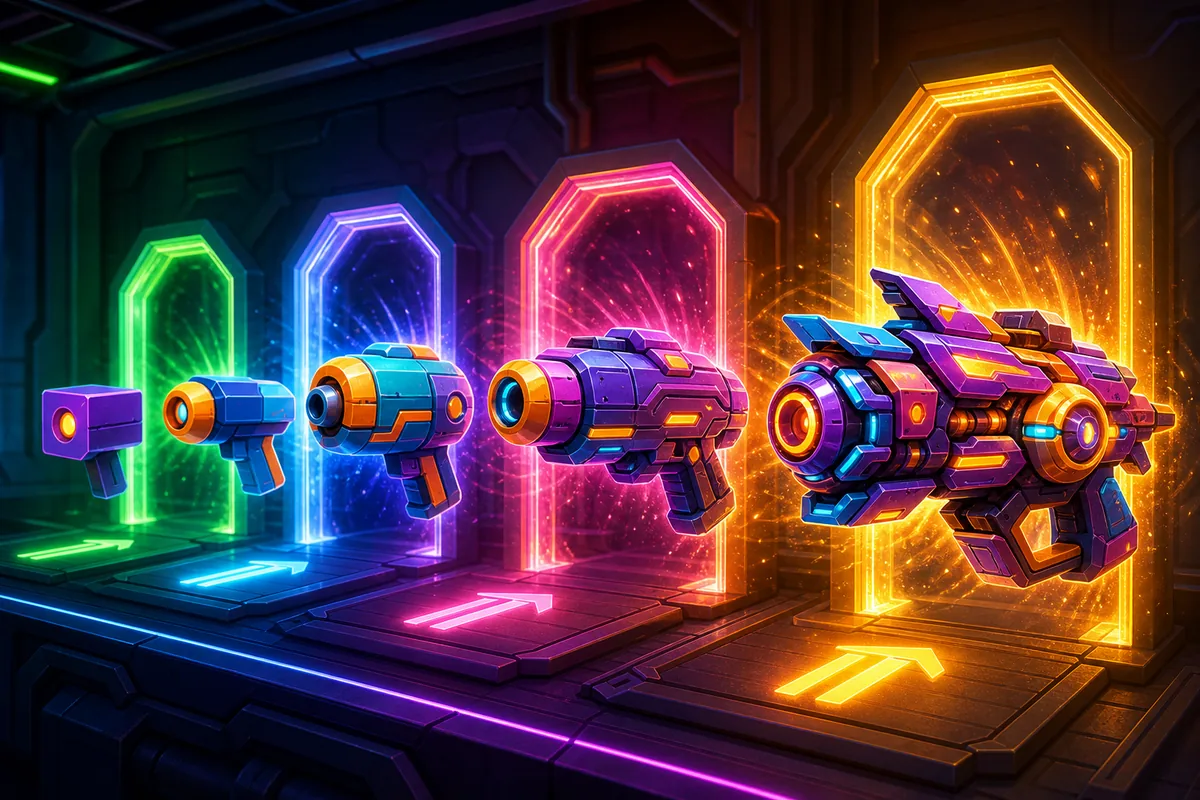
Gun Evolution Game presents change as a visible sequence along a forward-facing route. This article avoids repeating the description from the game page and instead studies the abstract design of transformation gates, object silhouettes, and color stages within a fictional arcade environment.
Design Review
Fictional Styling Keeps the Tone Abstract
Bright materials, oversized components, and geometric shapes move the design away from realism. That approach supports a playful transformation theme and keeps attention on visual progression.
Gates Divide the Route into Chapters
Glowing frames can mark transitions without adding long labels. Distinct colors separate one stage from another, while a clear floor arrow maintains forward direction. The hero image is original editorial artwork and uses imaginary sci-fi forms rather than realistic equipment.
A Sequence Makes Change Understandable
Placing forms from simple to complex lets the eye compare each stage directly. Consistent orientation is important: when every object points in the same direction, differences in size, color, and outline become easier to recognize.
Details in Focus
- One dominant color assigned to each transition.
- Open space between consecutive forms.
- A stable camera angle for fair comparison.
- Increasing visual complexity without losing the core silhouette.
Conclusion
The route communicates evolution through comparison. Repeated orientation establishes a baseline, colored gates divide the sequence, and increasingly elaborate shapes show change without requiring a dense interface.
Continue to the Game
Open Gun Evolution Game on GamesX. The title appears in Hypercasual Games, and further recent releases are available from the GamesX homepage.
Extended Design Review
In Gun Evolution Game, the technical importance of Design Review lies in how it affects visual hierarchy. The detail can be evaluated at thumbnail size and again at full width, revealing whether the hierarchy remains consistent. The specific note “Open space between consecutive forms” supplies an article-based reference, so the discussion can develop from material already established rather than from an invented feature. That critical boundary strengthens the article by separating observable design from speculation.
The clearest critical entry into Gun Evolution Game is the relationship summarized by Fictional Styling Keeps the Tone Abstract. Edges, scale changes, tonal separation, and negative space determine whether that relationship remains readable. The specific note “A stable camera angle for fair comparison” supplies an article-based reference, so the discussion can develop from material already established rather than from an invented feature. That critical boundary strengthens the article by separating observable design from speculation.
A design-focused review of Gun Evolution Game should test the article’s claim about Gates Divide the Route into Chapters against the whole composition. This method treats the image as a designed system rather than as evidence for mechanics that have not been documented. The specific note “Increasing visual complexity without losing the core silhouette” supplies an article-based reference, so the discussion can develop from material already established rather than from an invented feature. That critical boundary strengthens the article by separating observable design from speculation.
In Gun Evolution Game, the technical importance of A Sequence Makes Change Understandable lies in how it affects visual hierarchy. The detail can be evaluated at thumbnail size and again at full width, revealing whether the hierarchy remains consistent. The specific note “One dominant color assigned to each transition” supplies an article-based reference, so the discussion can develop from material already established rather than from an invented feature. That critical boundary strengthens the article by separating observable design from speculation.
The clearest critical entry into Gun Evolution Game is the relationship summarized by Details in Focus. Edges, scale changes, tonal separation, and negative space determine whether that relationship remains readable. The specific note “Open space between consecutive forms” supplies an article-based reference, so the discussion can develop from material already established rather than from an invented feature. That critical boundary strengthens the article by separating observable design from speculation.
A design-focused review of Gun Evolution Game should test the article’s claim about Conclusion against the whole composition. This method treats the image as a designed system rather than as evidence for mechanics that have not been documented. The specific note “A stable camera angle for fair comparison” supplies an article-based reference, so the discussion can develop from material already established rather than from an invented feature. That critical boundary strengthens the article by separating observable design from speculation.
In Gun Evolution Game, the technical importance of Continue to the Game lies in how it affects visual hierarchy. The detail can be evaluated at thumbnail size and again at full width, revealing whether the hierarchy remains consistent. The specific note “Increasing visual complexity without losing the core silhouette” supplies an article-based reference, so the discussion can develop from material already established rather than from an invented feature. That critical boundary strengthens the article by separating observable design from speculation.
The clearest critical entry into Gun Evolution Game is the relationship summarized by Design Review. Edges, scale changes, tonal separation, and negative space determine whether that relationship remains readable. The specific note “One dominant color assigned to each transition” supplies an article-based reference, so the discussion can develop from material already established rather than from an invented feature. That critical boundary strengthens the article by separating observable design from speculation.
A design-focused review of Gun Evolution Game should test the article’s claim about Fictional Styling Keeps the Tone Abstract against the whole composition. This method treats the image as a designed system rather than as evidence for mechanics that have not been documented. The specific note “Open space between consecutive forms” supplies an article-based reference, so the discussion can develop from material already established rather than from an invented feature. That critical boundary strengthens the article by separating observable design from speculation.