Impossible Car Stunt Game — A Review of Course Geometry
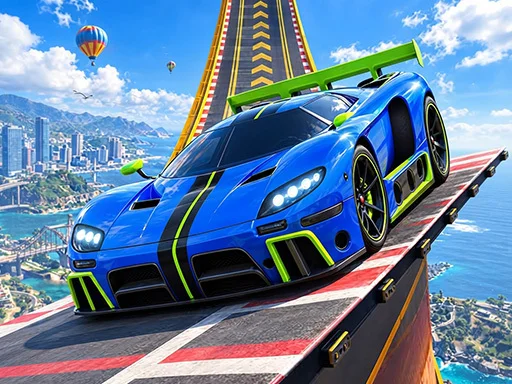
Impossible Car Stunt Game is built around the graphic problem of placing a car on an elevated stunt course. Ramps, narrow platforms, exposed edges, and directional references convert a familiar driving subject into a study of spatial legibility. The public presentation is strongest when height and route geometry remain clearer than spectacle.
Critical takeaway first
The course must communicate continuity even when sections are separated by open space. A player-facing camera can show the next ramp, but the relationship between the current platform and the landing region needs consistent scale. Without that connection, height becomes decoration rather than useful information.
The car functions as a measuring device. Its width clarifies how narrow a platform is, its orientation reveals the current route direction, and its distance from an edge gives the scene immediate tension. These readings do not depend on unverified physics or control claims.
Geometry before ornament
An elevated track benefits from strong silhouettes. Platform edges should remain visible against the sky or background, while ramps need enough tonal separation to show their incline. Decorative structures can establish theme, but they should not merge with the route.
Open space is an active design element. It isolates each stunt section and makes the transition between surfaces visually significant. At the same time, too much empty background can remove scale, so distant landmarks help preserve depth.
Camera and forward information
A useful view includes both the car’s current contact with the track and a readable portion of what comes next. If the camera focuses only on the vehicle, upcoming geometry becomes a surprise; if it looks too far ahead, the present alignment loses precision. Balance produces anticipation without abandoning control of the immediate frame.
Design details
- Track edges contrasted against open space.
- Ramp inclines visible before arrival.
- Car orientation aligned with the next platform.
- Distant references that preserve depth.
- Effects that clear quickly enough to reveal the landing area.
Reading risk without exaggeration
The name signals an impossible-stunt theme, but an editorial description should not invent levels, crashes, rewards, vehicle upgrades, time limits, or scoring. The visible course already communicates risk through height, narrow width, and discontinuity. Precision in describing those elements is more useful than promotional claims.
The technical success of the scene depends on hierarchy. The car is the active anchor, the current surface is the immediate constraint, the next platform is the forward objective of attention, and the background explains altitude. When those layers remain distinct, the viewer can understand a complex route at a glance.
Source and navigation
Inspect Impossible Car Stunt Game for the current published course. The Racing Games category provides a broader route through vehicle-based browser titles.
As a design study, Impossible Car Stunt Game demonstrates how a simple road can gain intensity when ordinary ground disappears. The resulting composition does not need constant visual noise. Clear geometry, stable perspective, and measured feedback are enough to make every visible transition matter.
Landing zones as visual conclusions
Every elevated transition needs a destination that reads before the car leaves its current surface. A landing zone gains clarity from visible width, a strong leading edge, and enough surrounding contrast to separate it from the background. The approach and destination should form one visual sentence.
After contact, the camera can reestablish the same hierarchy for the next section. This repeated reset is a technical strength: it prevents accumulated motion from turning the route into an unreadable sequence of disconnected ramps. Color contrast also helps separate a safe arrival surface from decorative structures beyond it. When the landing remains visible against the sky and surrounding geometry, the course communicates its direction through composition instead of relying on visual noise or excessive decoration.