Not Your Seafood Salad: Designing an Unexpected Kitchen Still Life
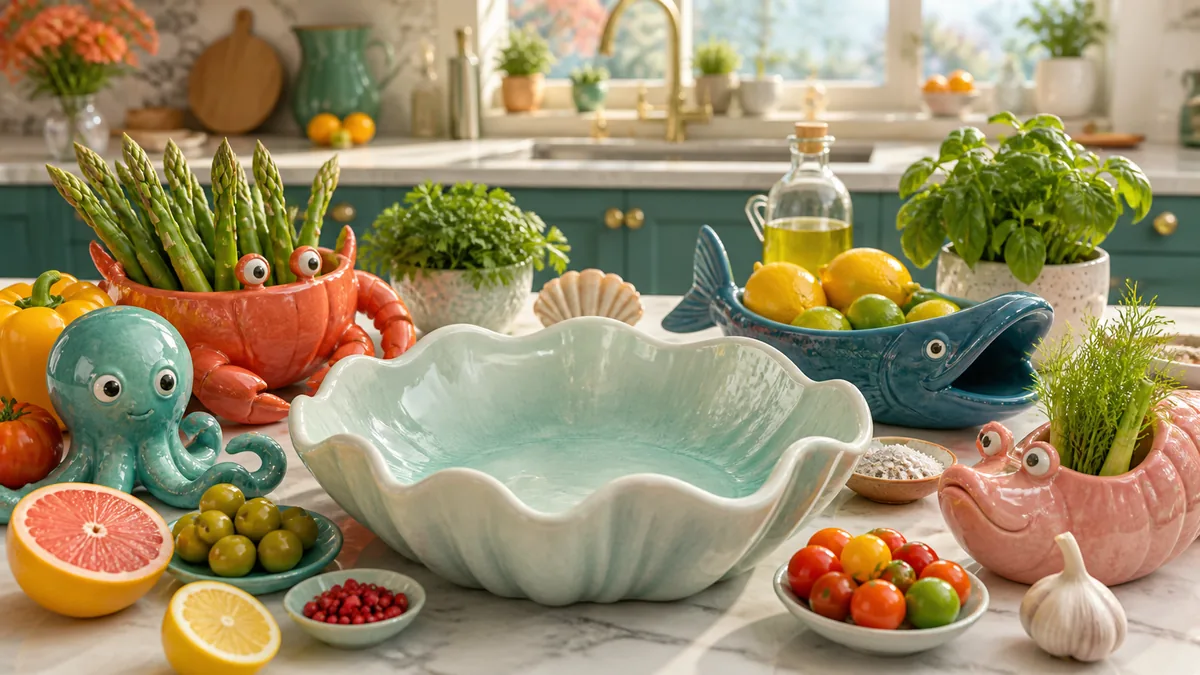
Not Your Seafood Salad has a title that invites visual contradiction and humor. This editorial composition approaches the theme as a bright kitchen still life, where familiar ingredients meet whimsical ocean-shaped serving pieces. It does not describe unconfirmed preparation steps.
Design Review
Color Keeps the Unusual Objects Connected
Citrus, tomatoes, herbs, olives, and peppers repeat the orange, green, and coral tones of the ceramic ocean figures. Daylight gives every surface a fresh appearance, while the neutral counter prevents the palette from becoming chaotic. The hero image is original editorial artwork, not a screenshot.
The Empty Bowl Creates Anticipation
A pale shell-shaped bowl occupies the center but contains nothing. Ingredients and decorative containers surround it, making the empty space the most active part of the scene. The arrangement suggests possibility without defining a recipe.
Details in Focus
- The central bowl anchors the composition.
- Citrus introduces bright directional accents.
- Ceramic figures supply gentle humor.
- Fresh herbs soften the hard kitchen surfaces.
Closing View
The scene feels unexpected because ordinary ingredients are arranged around playful objects. A clear center and repeated colors give the visual joke enough structure to remain readable.
Visit Not Your Seafood Salad
Open Not Your Seafood Salad on Gamesx, browse the Other Games category, or return to the homepage.
Extended Design Review
The clearest critical entry into Not Your Seafood Salad is the relationship summarized by Design Review. This method treats the image as a designed system rather than as evidence for mechanics that have not been documented. The specific note “Citrus introduces bright directional accents” supplies an article-based reference, so the discussion can develop from material already established rather than from an invented feature. It provides a more rigorous explanation while leaving the factual scope of the game page unchanged.
A design-focused review of Not Your Seafood Salad should test the article’s claim about Color Keeps the Unusual Objects Connected against the whole composition. The detail can be evaluated at thumbnail size and again at full width, revealing whether the hierarchy remains consistent. The specific note “Ceramic figures supply gentle humor” supplies an article-based reference, so the discussion can develop from material already established rather than from an invented feature. It provides a more rigorous explanation while leaving the factual scope of the game page unchanged.
In Not Your Seafood Salad, the technical importance of The Empty Bowl Creates Anticipation lies in how it affects visual hierarchy. Edges, scale changes, tonal separation, and negative space determine whether that relationship remains readable. The specific note “Fresh herbs soften the hard kitchen surfaces” supplies an article-based reference, so the discussion can develop from material already established rather than from an invented feature. It provides a more rigorous explanation while leaving the factual scope of the game page unchanged.
The clearest critical entry into Not Your Seafood Salad is the relationship summarized by Details in Focus. This method treats the image as a designed system rather than as evidence for mechanics that have not been documented. The specific note “The central bowl anchors the composition” supplies an article-based reference, so the discussion can develop from material already established rather than from an invented feature. It provides a more rigorous explanation while leaving the factual scope of the game page unchanged.
A design-focused review of Not Your Seafood Salad should test the article’s claim about Closing View against the whole composition. The detail can be evaluated at thumbnail size and again at full width, revealing whether the hierarchy remains consistent. The specific note “Citrus introduces bright directional accents” supplies an article-based reference, so the discussion can develop from material already established rather than from an invented feature. It provides a more rigorous explanation while leaving the factual scope of the game page unchanged.
In Not Your Seafood Salad, the technical importance of Visit Not Your Seafood Salad lies in how it affects visual hierarchy. Edges, scale changes, tonal separation, and negative space determine whether that relationship remains readable. The specific note “Ceramic figures supply gentle humor” supplies an article-based reference, so the discussion can develop from material already established rather than from an invented feature. It provides a more rigorous explanation while leaving the factual scope of the game page unchanged.
The clearest critical entry into Not Your Seafood Salad is the relationship summarized by Design Review. This method treats the image as a designed system rather than as evidence for mechanics that have not been documented. The specific note “Fresh herbs soften the hard kitchen surfaces” supplies an article-based reference, so the discussion can develop from material already established rather than from an invented feature. It provides a more rigorous explanation while leaving the factual scope of the game page unchanged.
A design-focused review of Not Your Seafood Salad should test the article’s claim about Color Keeps the Unusual Objects Connected against the whole composition. The detail can be evaluated at thumbnail size and again at full width, revealing whether the hierarchy remains consistent. The specific note “The central bowl anchors the composition” supplies an article-based reference, so the discussion can develop from material already established rather than from an invented feature. It provides a more rigorous explanation while leaving the factual scope of the game page unchanged.
In Not Your Seafood Salad, the technical importance of The Empty Bowl Creates Anticipation lies in how it affects visual hierarchy. Edges, scale changes, tonal separation, and negative space determine whether that relationship remains readable. The specific note “Citrus introduces bright directional accents” supplies an article-based reference, so the discussion can develop from material already established rather than from an invented feature. It provides a more rigorous explanation while leaving the factual scope of the game page unchanged.