Offroad Mud Truck: Reading Traction Through Terrain
Offroad Mud Truck shifts driving away from smooth asphalt and into terrain where every rut becomes visual information. Its confirmed controls use WASD or the Arrow keys for driving and steering. This article studies the relationship between a heavy vehicle, an uneven route, and deliberate directional input.
Design Review
Atmosphere From Physical Detail
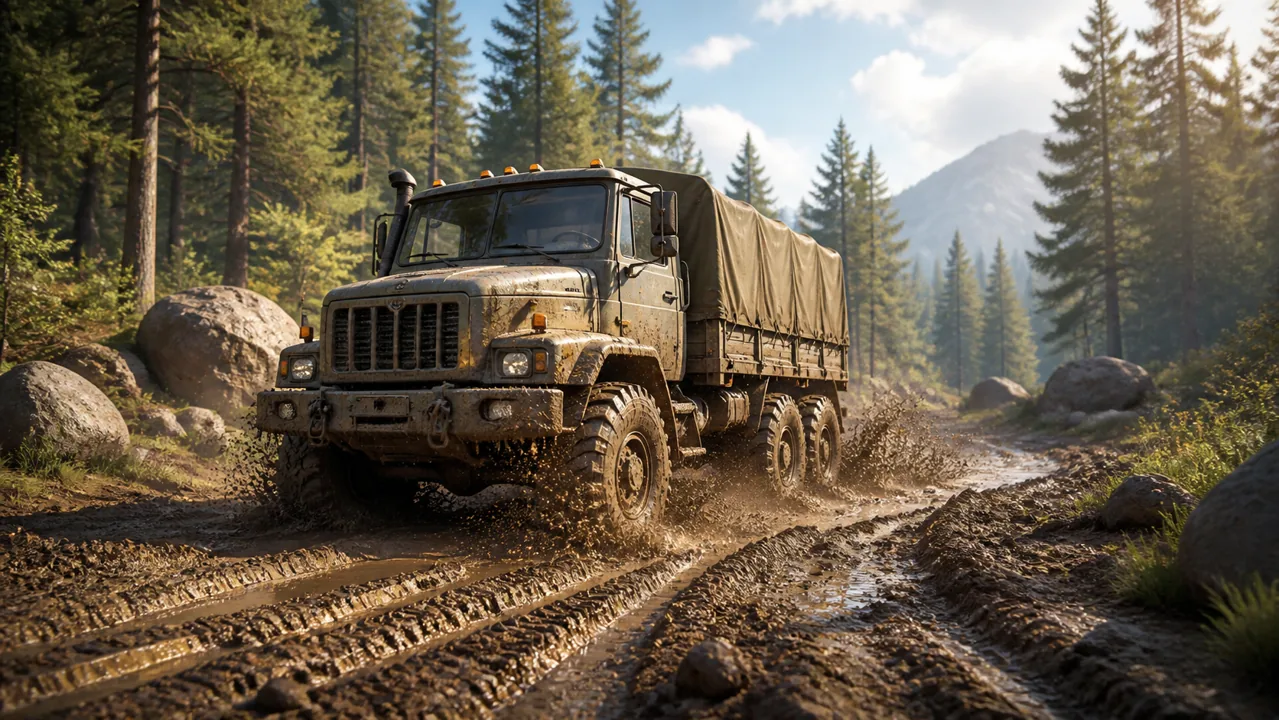
Controlled splashes, compressed suspension, and rotating tires can suggest weight without excessive visual effects. Forest light and distant mountains establish scale, while the immediate trail remains the strongest part of the composition.
Steering a Large Silhouette
A heavy truck occupies more visual space than a compact car. Its wheelbase, body width, and turning arc make route boundaries especially important. Small directional corrections can be easier to interpret than abrupt changes when the ground is irregular.
Mud Makes the Surface Visible
A paved road often hides small changes in traction. Mud reveals them through tire tracks, splashes, darker patches, and uneven grooves. These cues can show where a truck has traveled and help distinguish a stable path from a difficult section.
The forest-trail illustration is original editorial artwork featuring a generic unbranded truck. It is not a screenshot from the game.
Details in Focus
- Existing tire tracks that indicate route direction.
- Rocks and trees marking the usable width.
- Changes in mud color and surface texture.
- The truck’s alignment before a narrow section.
Conclusion
The title’s identity comes from the surface beneath the vehicle. Directional controls remain familiar, but mud, tracks, and obstacles give every steering choice a visible context. Reading the terrain before making a larger correction provides the clearest way to understand that relationship.
Game Access and Related Adventures
Offroad Mud Truck opens on GamesX. Related journeys appear in the Adventure Games category. The GamesX homepage lists new releases and additional sections.
Extended Design Review
The clearest critical entry into Offroad Mud Truck is the relationship summarized by Design Review. This method treats the image as a designed system rather than as evidence for mechanics that have not been documented. The specific note “Rocks and trees marking the usable width” supplies an article-based reference, so the discussion can develop from material already established rather than from an invented feature. It provides a more rigorous explanation while leaving the factual scope of the game page unchanged.
A design-focused review of Offroad Mud Truck should test the article’s claim about Atmosphere From Physical Detail against the whole composition. The detail can be evaluated at thumbnail size and again at full width, revealing whether the hierarchy remains consistent. The specific note “Changes in mud color and surface texture” supplies an article-based reference, so the discussion can develop from material already established rather than from an invented feature. It provides a more rigorous explanation while leaving the factual scope of the game page unchanged.
In Offroad Mud Truck, the technical importance of Steering a Large Silhouette lies in how it affects visual hierarchy. Edges, scale changes, tonal separation, and negative space determine whether that relationship remains readable. The specific note “The truck’s alignment before a narrow section” supplies an article-based reference, so the discussion can develop from material already established rather than from an invented feature. It provides a more rigorous explanation while leaving the factual scope of the game page unchanged.
The clearest critical entry into Offroad Mud Truck is the relationship summarized by Mud Makes the Surface Visible. This method treats the image as a designed system rather than as evidence for mechanics that have not been documented. The specific note “Existing tire tracks that indicate route direction” supplies an article-based reference, so the discussion can develop from material already established rather than from an invented feature. It provides a more rigorous explanation while leaving the factual scope of the game page unchanged.
A design-focused review of Offroad Mud Truck should test the article’s claim about Details in Focus against the whole composition. The detail can be evaluated at thumbnail size and again at full width, revealing whether the hierarchy remains consistent. The specific note “Rocks and trees marking the usable width” supplies an article-based reference, so the discussion can develop from material already established rather than from an invented feature. It provides a more rigorous explanation while leaving the factual scope of the game page unchanged.
In Offroad Mud Truck, the technical importance of Conclusion lies in how it affects visual hierarchy. Edges, scale changes, tonal separation, and negative space determine whether that relationship remains readable. The specific note “Changes in mud color and surface texture” supplies an article-based reference, so the discussion can develop from material already established rather than from an invented feature. It provides a more rigorous explanation while leaving the factual scope of the game page unchanged.
The clearest critical entry into Offroad Mud Truck is the relationship summarized by Game Access and Related Adventures. This method treats the image as a designed system rather than as evidence for mechanics that have not been documented. The specific note “The truck’s alignment before a narrow section” supplies an article-based reference, so the discussion can develop from material already established rather than from an invented feature. It provides a more rigorous explanation while leaving the factual scope of the game page unchanged.
A design-focused review of Offroad Mud Truck should test the article’s claim about Design Review against the whole composition. The detail can be evaluated at thumbnail size and again at full width, revealing whether the hierarchy remains consistent. The specific note “Existing tire tracks that indicate route direction” supplies an article-based reference, so the discussion can develop from material already established rather than from an invented feature. It provides a more rigorous explanation while leaving the factual scope of the game page unchanged.