Ragdoll Teleport Arena: A Design Review of Sudden Space
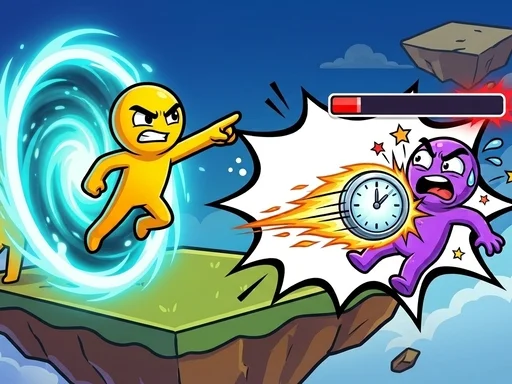
Ragdoll Teleport Arena combines physics-driven character movement with abrupt changes in position. A ragdoll figure, teleport points, obstacles, opponents, and impact feedback occupy a compact arena where spatial continuity can disappear in an instant. The design challenge is to make each sudden relocation surprising without making the resulting scene impossible to read.
Feedback after the teleport
The most important frame is often the one immediately following relocation. The player needs to identify the new position, nearby hazards, and the direction in which the ragdoll is already moving. A clear arrival effect can mark the transition, but it should fade quickly enough to expose the practical state of the arena.
Impact feedback performs a different role. It explains contact between character, obstacle, or opponent and shows how the physics system has changed momentum. Teleportation explains where the figure appeared; collision feedback explains what happened next. Keeping those visual events distinct improves comprehension.
Physics before visual decoration
Ragdoll motion communicates force through rotation, collapse, and recovery. These movements are expressive, yet they also carry functional information. The body’s orientation can indicate whether momentum continues toward a hazard or whether the figure has settled into a controllable region.
Background detail should therefore remain subordinate to silhouettes and edges. Obstacles need recognizable boundaries, and opponents must stay visually separate from the ragdoll. The arena can be colorful without giving every surface equal emphasis.
Teleport points as interface objects
A teleport point is part of the environment and part of the control language. Its location defines a possible transition, while its appearance distinguishes it from an ordinary platform or decoration. Consistency matters: similar points should look related so their purpose can be recognized before a sudden move occurs.
Arena details
- Arrival effects should reveal rather than conceal the new position.
- Obstacle edges provide stable references during unstable motion.
- Ragdoll orientation communicates remaining momentum.
- Opponent silhouettes help separate conflict from environmental collision.
- Impact effects work best when tied to a precise event.
Critical takeaway
The title’s visual identity depends on a productive contradiction: movement is deliberately unpredictable, but the arena must remain legible. Teleportation creates discontinuity, while consistent landmarks restore orientation. Ragdoll physics creates comic instability, while clear collision feedback explains cause and result.
This balance is stronger than spectacle alone. If a relocation produces only a bright effect, the player loses context. If physics movement occurs without clear boundaries, an impact feels arbitrary. The design succeeds when surprise is followed by rapid visual understanding.
Momentum as a temporary map
Traditional navigation depends on fixed routes. Here, the direction of the moving ragdoll becomes a short-lived route of its own. Watching rotation and travel reveals where the character is likely to meet the arena next. This makes momentum a visual map that must be redrawn after every teleport or collision.
Stable objects remain essential because they allow that moving map to be measured. A wall, platform edge, or teleport marker provides a fixed comparison. The player can then judge not only current location but the relationship between direction and the next boundary.
Source and navigation
View the complete public presentation on the Ragdoll Teleport Arena page. The Arcade Games category offers more browser titles with direct visual interaction.
The review remains limited to confirmed screen elements and avoids claims about undocumented stages, scoring, upgrades, or modes. What is visible already provides a strong design subject: an arena where position can change instantly and clarity must be rebuilt just as quickly.
Sound may reinforce arrival or impact when enabled, but the visual state still needs to stand on its own. A player should be able to locate the ragdoll, identify the closest boundary, and recognize the next hazard from the screen. That independence keeps the interaction understandable across different browser and device configurations.