Tug Pull Crash Challenge — A Design Review of Opposing Force
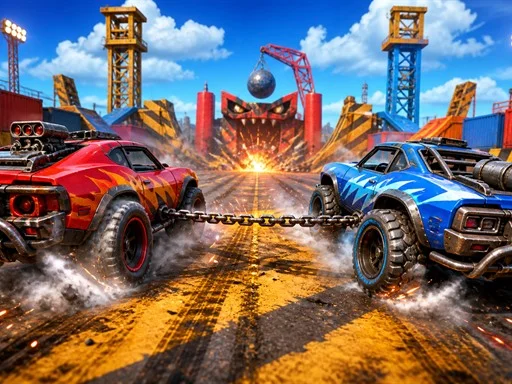
Tug Pull Crash Challenge presents a vehicle-based confrontation through opposing positions, a connecting pull line, road boundaries, and changing spatial cues. Its design interest comes less from unverified crash systems than from a simple graphic question: how can two directions of force remain readable inside one moving scene?
Critical takeaway first
The composition succeeds when the vehicles, connection, and available road space form one clear relationship. If either vehicle blends into the background, the central tension becomes difficult to understand. Strong silhouettes and an unobstructed line between the opposing sides create immediate visual logic.
Distance is the main measurement. The space between the vehicles shows the scale of the confrontation, while the remaining road around them explains how constrained the scene has become. Effects should clarify a change in that distance instead of hiding it.
Opposition needs a stable axis
A pull scene naturally creates an axis between two points. Road markings, barrier edges, or the connecting line can reinforce that direction. When these references agree, the eye understands where force is visually concentrated. A tilted or curved environment can add energy, but it should not obscure the basic opposition.
Vehicle orientation also matters. The body shape and wheel alignment establish which way each side faces. Consistent perspective lets the viewer compare size and position without relying on claims about engine power, physics, upgrades, or control behavior.
Feedback and recovery
A sudden movement or impact effect may briefly dominate the frame. Its design value appears after it clears: the new spacing, altered alignment, or shifted focal point should be visible. This recovery period prevents spectacle from replacing information.
Interface cues belong outside the main axis whenever possible. Stable panels can report the current state while the vehicles and road retain visual priority.
Design details
- Distinct silhouettes for both opposing vehicles.
- A visible connection that does not merge with the road.
- Enough surrounding space to compare movement.
- Effects that reveal rather than conceal the resulting state.
- Consistent boundaries that preserve direction.
Reading the challenge without exaggeration
The title signals pulling, crashing, and competition, but an editorial review should not invent rounds, rewards, damage models, opponents, upgrades, or scoring systems. The confirmed public imagery already supports a focused analysis of opposing force. Two anchors occupy the scene, the space between them changes, and the road provides a stable reference.
This restraint improves accuracy and highlights the design problem itself. The viewer does not need promotional claims to understand why alignment, distance, and contrast matter.
Scale across a narrow roadway
A compact road intensifies the relationship because there is less empty space around the vehicles. Barriers and markings become measuring tools, showing how much the composition has shifted. Background scenery can add atmosphere, but it should remain subordinate to the active axis.
The most coherent sequence is visual: establish both sides, follow the connection, observe the change, and inspect the resulting arrangement. Repeating that sequence gives the scene rhythm while keeping every event tied to the same readable structure.
Source and navigation
Inspect Tug Pull Crash Challenge for the current public version. The Racing Games category supplies a broader navigation path through vehicle-focused browser titles.
A final design consideration is symmetry. Perfect symmetry explains the contest instantly, but small differences in angle, color, or background position prevent the image from becoming static. The challenge is to add variation without weakening the shared axis.
When the roadway, vehicles, and connection preserve that relationship, the scene communicates pressure before any effect appears. Movement then modifies an understandable structure. This is more durable than depending on constant impact imagery because every new state can be compared with a clear starting arrangement and consistent road boundaries.